<?xml version="1.0" encoding="utf-8"?><feed xmlns="http://www.w3.org/2005/Atom" ><generator uri="https://jekyllrb.com/" version="3.10.0">Jekyll</generator><link href="/feed.xml" rel="self" type="application/atom+xml" /><link href="/" rel="alternate" type="text/html" /><updated>2026-04-08T22:28:48+00:00</updated><id>/feed.xml</id><title type="html">Syler Wagner</title><subtitle>Software engineer, builder, and tinkerer.</subtitle><entry><title type="html">6 Years of Meditation Data Reveals a Depressing Picture</title><link href="/posts/6-years-of-meditation-data-reveals-a-depressing-picture/" rel="alternate" type="text/html" title="6 Years of Meditation Data Reveals a Depressing Picture" /><published>2025-02-19T00:00:00+00:00</published><updated>2025-02-19T00:00:00+00:00</updated><id>/posts/6-years-of-meditation-data-reveals-a-depressing-picture</id><content type="html" xml:base="/posts/6-years-of-meditation-data-reveals-a-depressing-picture/"><![CDATA[<p>I recently posted a summary of my recent experiments investigating the impact meditation, where I found meditating more increased many negative emotions like frustration, anxiety, and depression. This is a follow-up post with a deeper dive into my historical data and includes periods of time where I alternated between not meditating, and meditating daily.</p>

<h2 id="design">Design</h2>

<h3 id="data-selection">Data Selection</h3>

<p>I identified historical periods of time when I switched between not meditating, and a daily meditation practice. I included the following:</p>

<p><img src="/assets/images/posts/meta-meditation-overview.png" alt="Meditation periods overview" /></p>

<ol>
  <li><strong>Started Meditating (2018)</strong> 0 vs an average 12 min/day. I included 60 days of no meditation, and 60 days of meditation in the analysis for a total of 120 days. I used guided meditation with the <a href="https://www.wakingup.com/">Waking Up app</a>.</li>
  <li><strong>Started Again (2020)</strong> 0 vs 36 min/day, 41 days each.</li>
  <li><strong>Quit Meditating (2021)</strong> 28 vs 0 min/day, 58 days each.</li>
  <li><strong>Started Again (2022)</strong> 0 vs 16 min/day, 39 days each.</li>
</ol>

<p>In (2, 3, 4) I used a mantra-based meditation style described in the book <a href="https://www.amazon.com/Stress-Less-Accomplish-More-Extraordinary/dp/0062747509">Stress Less, Accomplish More: Meditation for Extraordinary Performance</a>.</p>

<p>In addition to the above retroactively examined periods, I included three experiments with a random daily schedule which I ran with the <a href="https://apps.apple.com/app/apple-store/id6463800032?pt=126584930&amp;ct=WarAgainstEntropy&amp;mt=8">Reflect</a> app:</p>

<ol>
  <li><strong>Random Experiment (2024)</strong> 0 vs 30 min, 90 days total.</li>
  <li><strong>Random Experiment (2024)</strong> 15 vs 30 min, 30 days total.</li>
  <li><strong>Longer Random Experiment (2024-2025)</strong> 15 vs 30 min, 204 days total.</li>
</ol>

<p>For these three experiments, I primarily did mindfulness and “<a href="https://zenstudiespodcast.com/shikantaza/">just sitting</a>” meditation.</p>

<p>This comes out to a total of 720 days included in the analysis. I intentionally excluded periods of time where my meditation time was highly variable in a non-randomized fashion, long sections where it was stable, and periods where changes in meditation status overlapped with major life changes.</p>

<h3 id="data-analysis">Data Analysis</h3>

<p>I imported historical data on mood and meditation into the <a href="https://apps.apple.com/app/apple-store/id6463800032?pt=126584930&amp;ct=WarAgainstEntropy&amp;mt=8">Reflect</a> app and created retroactive crossover style experiments for the sections identified above, adding measures of mood and my Oura ring sleep and recovery data as dependent variables.</p>

<p>I added the ability to generate <a href="https://en.wikipedia.org/wiki/Forest_plot">forest plots</a> to pool data from multiple experiments in Reflect, in true meta-analysis fashion.</p>

<h2 id="results">Results</h2>

<h3 id="mood">Mood</h3>

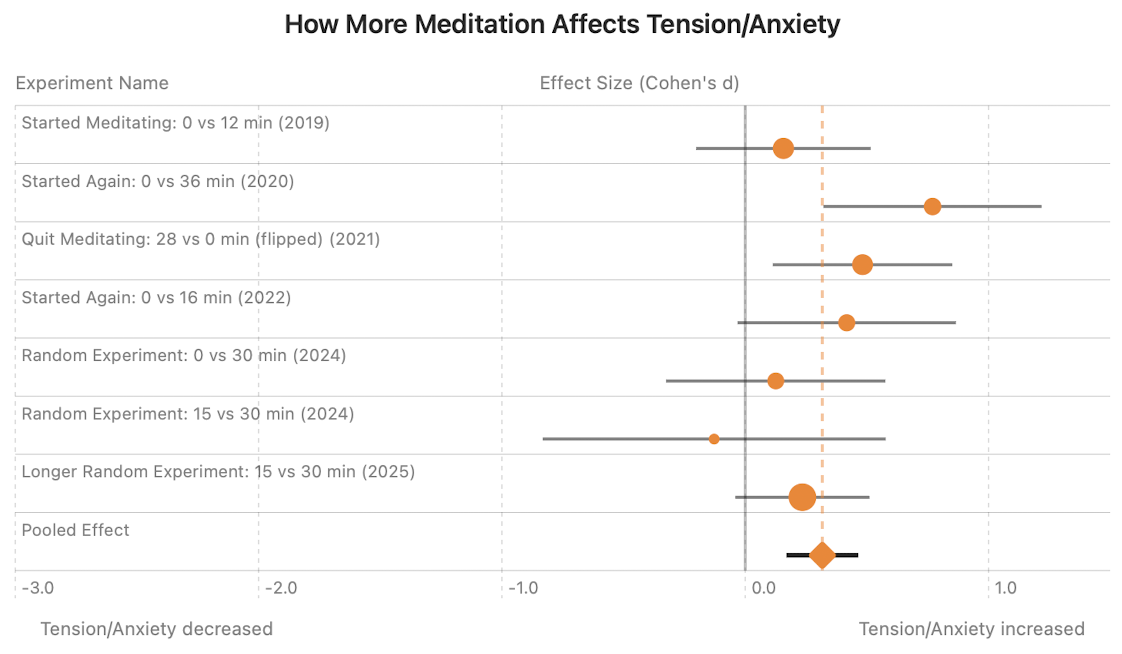
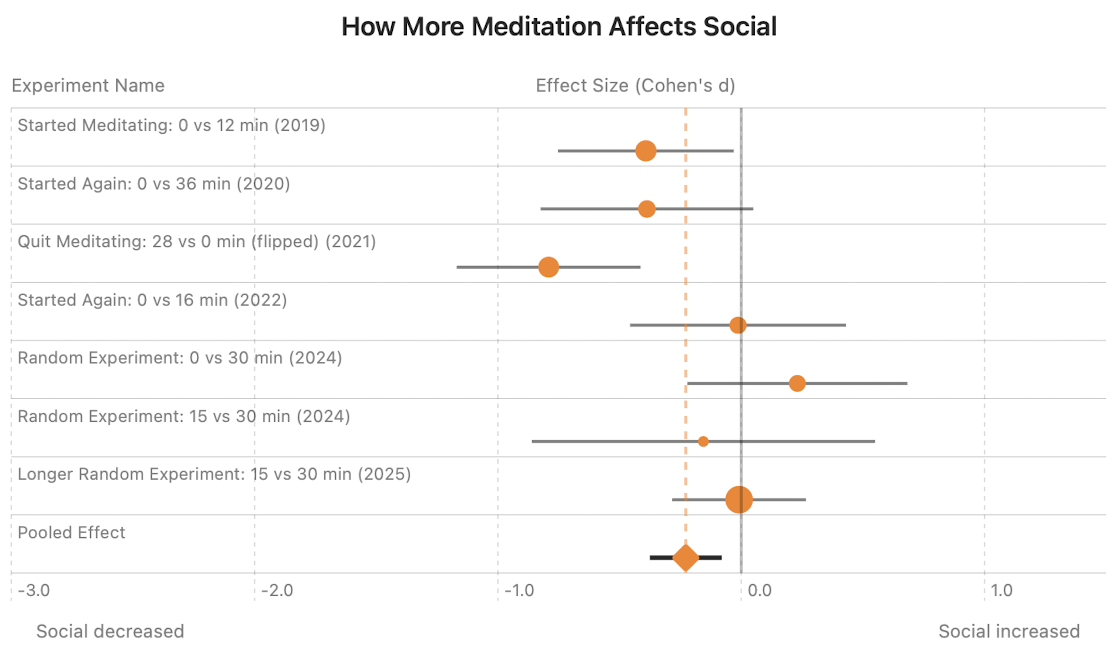
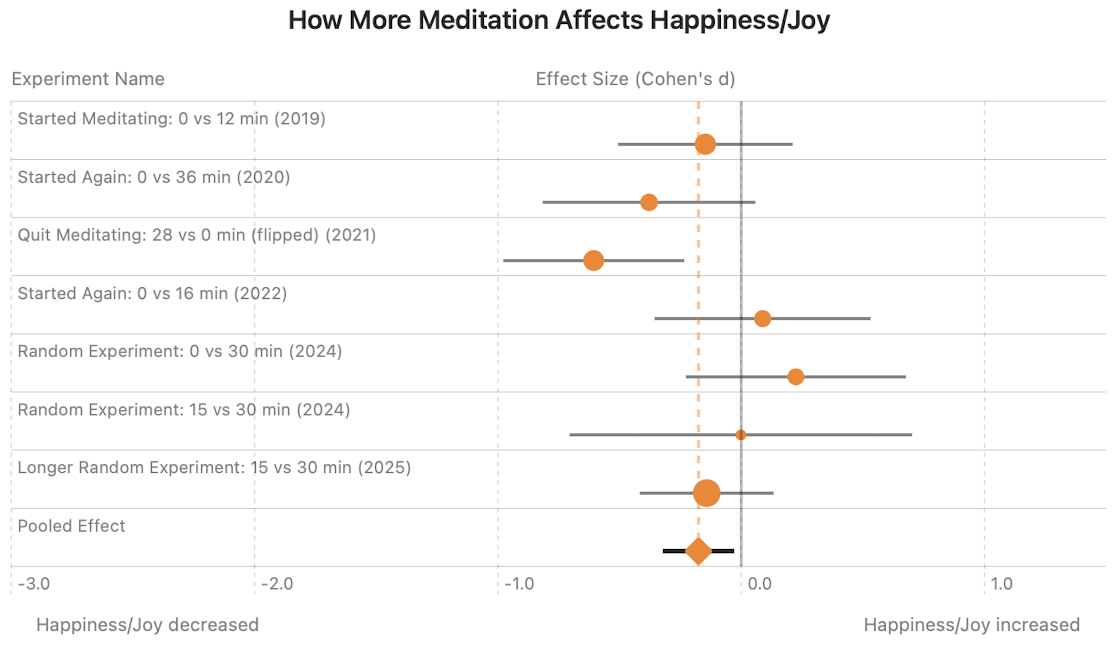
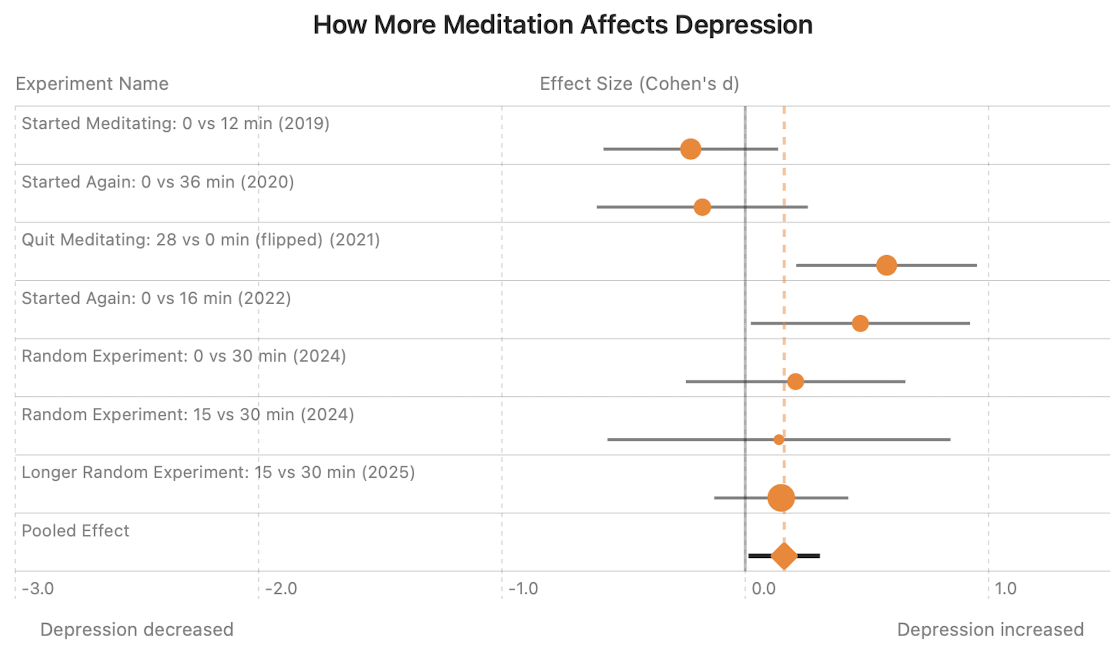
<p>While the results of the individual studies were variable, the overall pooled data presented the following with higher meditation time:</p>

<ul>
  <li>Increased tension/anxiety</li>
  <li>Decreased how social I felt</li>
  <li>Decreased happiness/joy</li>
  <li>Increased depression</li>
</ul>

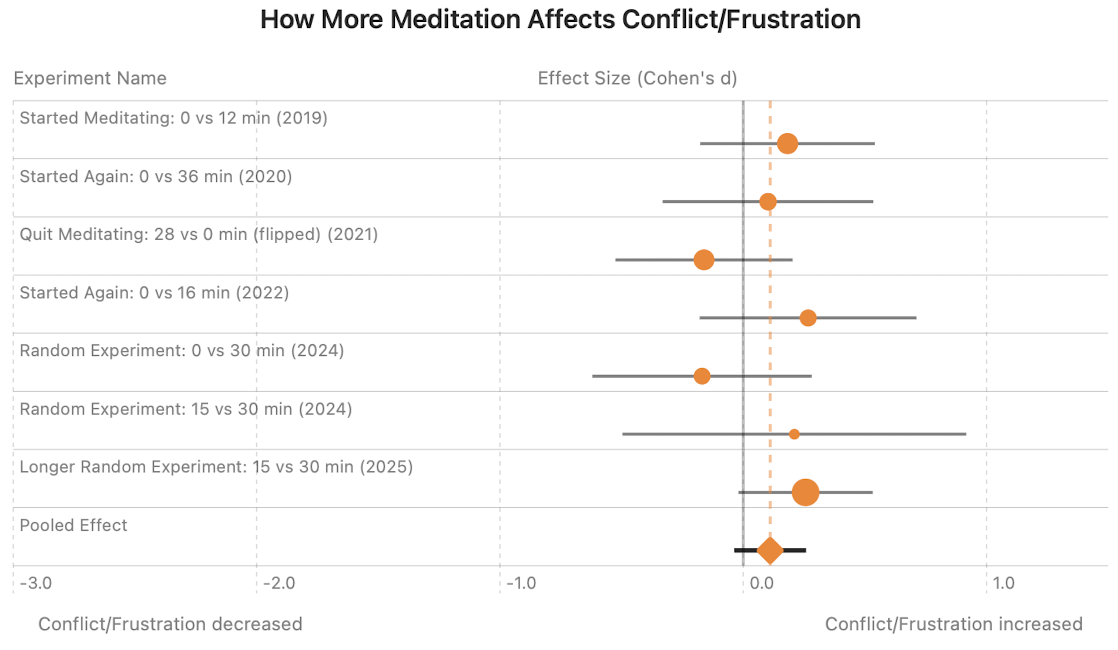
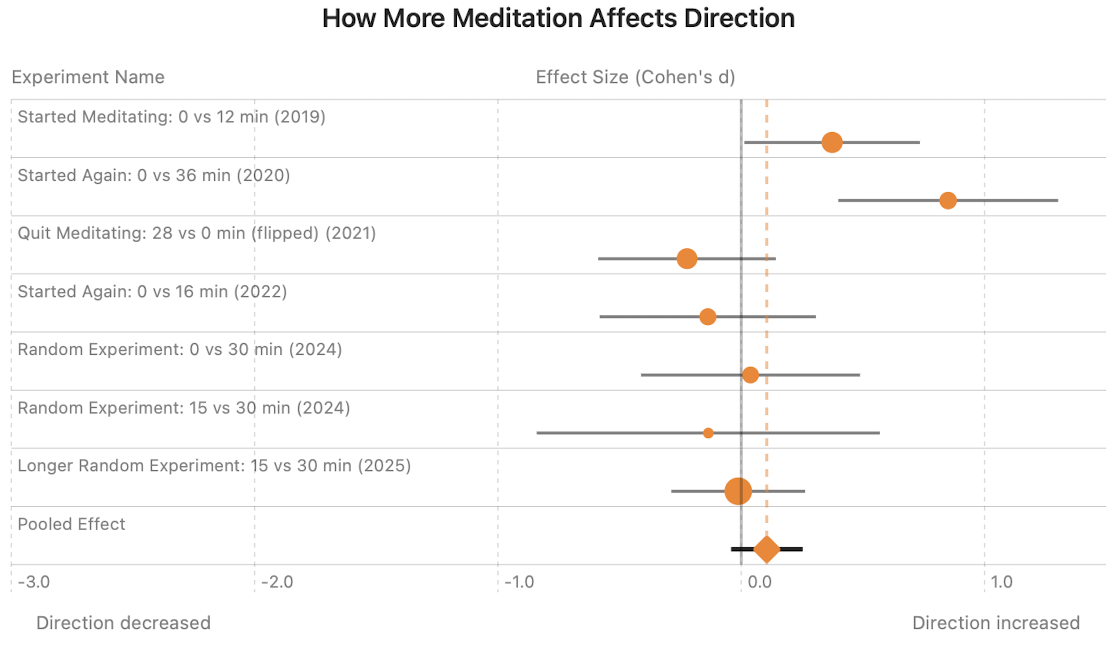
<p>The following were lower confidence changes, where the 95% confidence interval for the pooled effect intercepted the “no effect” line:</p>

<ul>
  <li>Increased conflict/frustration</li>
  <li>Increased direction</li>
  <li>Decreased fatigue</li>
</ul>

<p>I also measured energy/vigor, and the pooled effect for that was basically zero.</p>

<p><img src="/assets/images/posts/meta-mood-forest-plot.png" alt="Pooled mood forest plot" />
<em>Note: I used Cohen’s d as a measure of effect instead of odds ratios in the forest plot, as I think it makes for more intuitive reading to have the “zero effect” line at zero.</em></p>

<p>This seems to conflict with published research I initially found on the topic. According to <a href="https://jamanetwork.com/journals/jamainternalmedicine/fullarticle/1809754">Meditation Programs for Psychological Stress and Well-being: A Systematic Review and Meta-analysis</a> by Goyal et al. (2014), meditation was associated with decreases in anxiety and depression.</p>

<p><img src="/assets/images/posts/meta-tension-anxiety.png" alt="Tension/anxiety forest plot" /></p>

<p><img src="/assets/images/posts/meta-social.png" alt="Social forest plot" /></p>

<p><img src="/assets/images/posts/meta-depression.png" alt="Depression forest plot" /></p>

<p>This was an interesting result, which also conflicts with published research just like my findings on tension/anxiety. I did notice a decrease in depression on my first two attempts at regular meditation, but the pattern seemed to invert after that, with more meditation leading to increased depressive symptoms.</p>

<p>It could be that this is a legitimate “novice meditator” effect that tends to wash out or invert later in one’s meditation practice, so it would make sense to see an alleviation in depressive symptoms if the majority of published research is performed on novice meditators.</p>

<p><img src="/assets/images/posts/meta-happiness.png" alt="Happiness forest plot" /></p>

<p><img src="/assets/images/posts/meta-direction.png" alt="Direction forest plot" /></p>

<p>Here is another result where my first two regular meditation attempts depart from the successive ones, with significant increases in my subjective feeling of direction/focus in life.</p>

<h3 id="sleep--recovery">Sleep &amp; Recovery</h3>

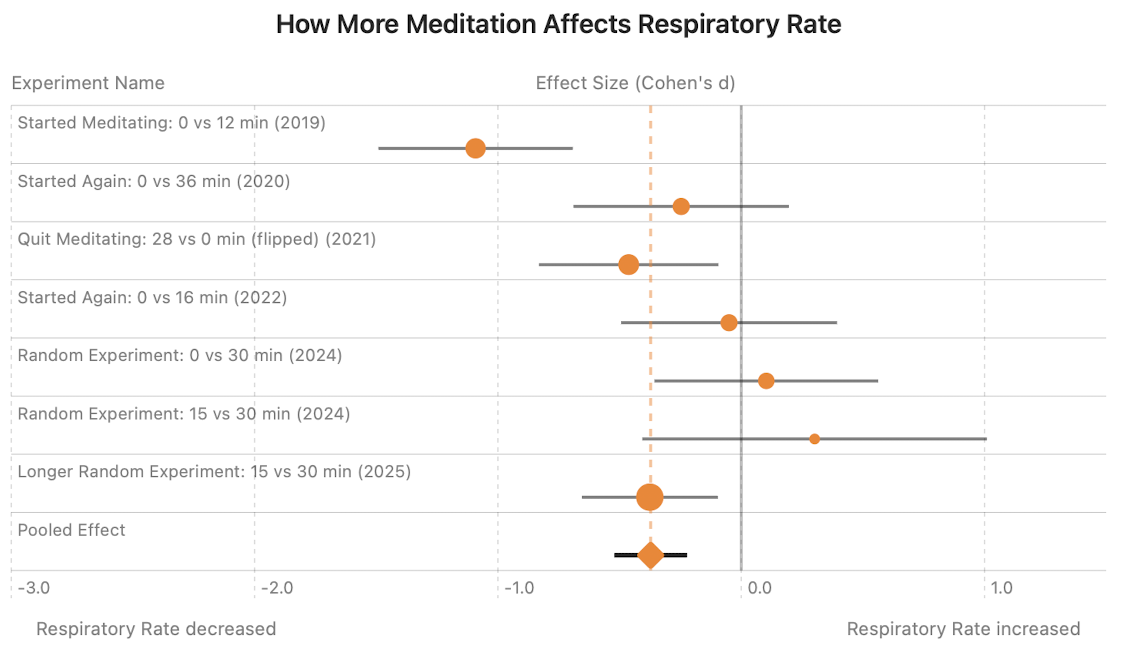
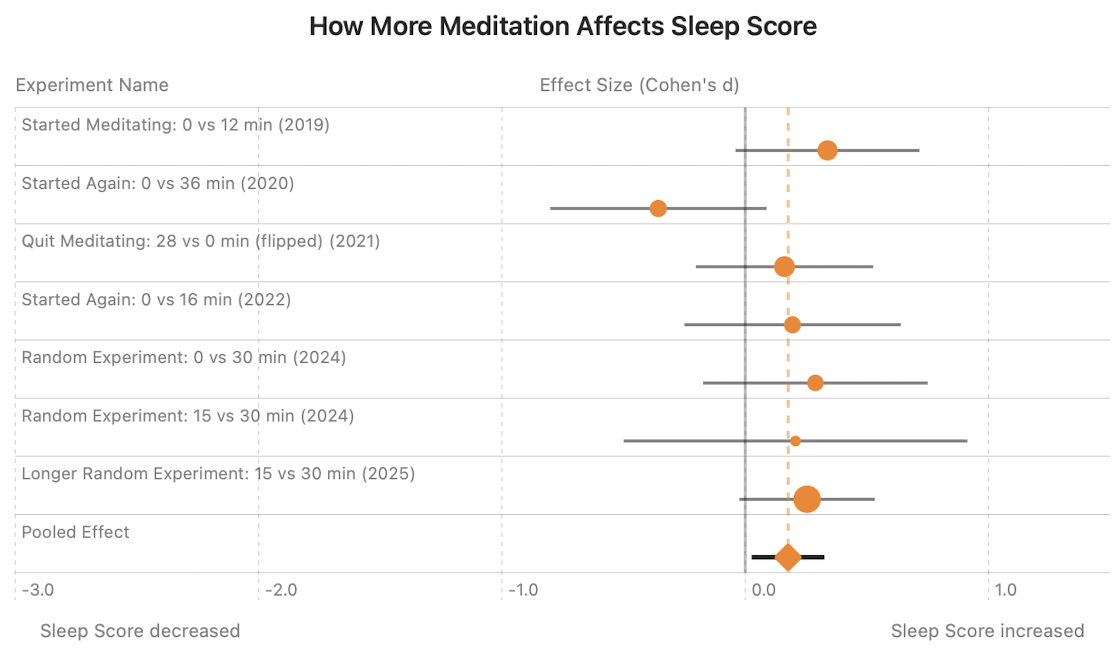
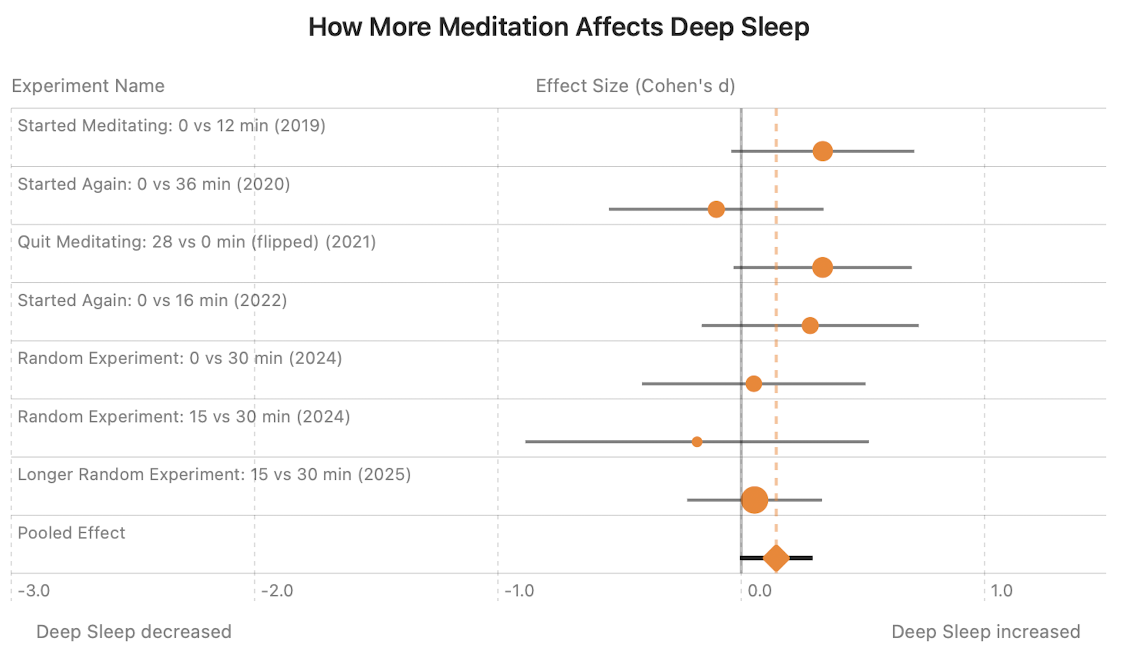
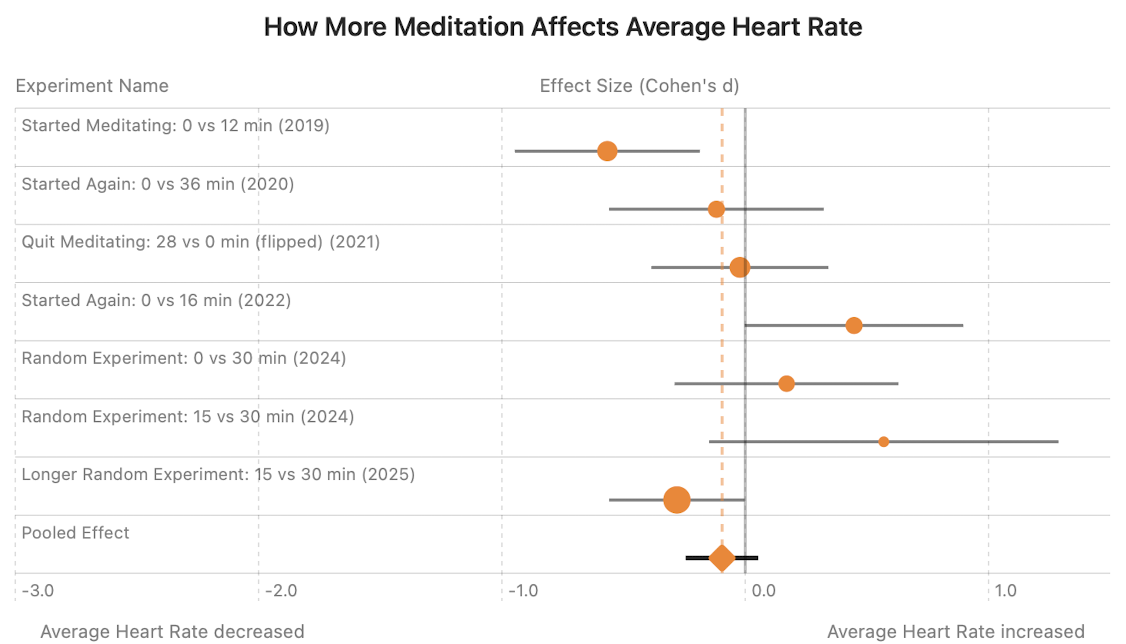
<p>I used an <a href="https://ouraring.com/">Oura</a> ring to track my sleep and recovery data. I found the following effects of increased meditation time (all measured on the night after):</p>

<ul>
  <li>Decreased respiratory rate</li>
  <li>Increased sleep score and deep sleep duration</li>
</ul>

<p>The following were lower confidence changes:</p>

<ul>
  <li>Decreased average heart rate during sleep</li>
  <li>Slightly higher HRV</li>
</ul>

<p><img src="/assets/images/posts/meta-sleep-respiratory.png" alt="Respiratory rate forest plot" /></p>

<p><img src="/assets/images/posts/meta-sleep-score.png" alt="Sleep score forest plot" /></p>

<p><img src="/assets/images/posts/meta-sleep-hr.png" alt="Heart rate forest plot" /></p>

<p><img src="/assets/images/posts/meta-sleep-hrv.png" alt="HRV forest plot" /></p>

<p>The improvements in sleep I found seemed to match existing scientific findings on mindfulness meditation improving sleep quality. See <a href="https://nyaspubs.onlinelibrary.wiley.com/doi/full/10.1111/nyas.13996">The Effect of Mindfulness Meditation on Sleep Quality: A Systematic Review and Meta-Analysis of Randomized Controlled Trials</a> by Rusch et al. (2018).</p>

<h2 id="discussion">Discussion</h2>

<p>When I started out formally experimenting with meditation, I was not expecting to find an increase in negative emotions as a measurable effect. As I slowly started to work my way back and retroactively analyze my historical data, I was additionally surprised to find that a lot of the negative impact on mood was consistent across time. My baseline level of negative emotion is quite low, so a small increase in anxiety or depression didn’t represent a noticeable difference. I lived through years of regular meditation without picking up on the overall pattern until I did some careful data analysis.</p>

<p>I don’t think the data presented above provide the full picture, as one (albeit less quantifiable) subjective effect I’ve experienced from meditation is an increase in detachment from my negative emotions when they do arise.</p>

<p>I shared my initial findings on Reddit, and was met with three main responses:</p>

<ol>
  <li>People who thought my findings were unexpected and interesting</li>
  <li>People who suggested that increased negative emotion is expected and normal during meditation (most of whom encouraged me to continue)</li>
  <li>People who had experienced similar negative emotion increases from meditation and had abandoned meditating as a result</li>
</ol>

<p>There was one <a href="https://www.reddit.com/r/Meditation/comments/1iozx3q/comment/mco1tjn/">nuanced comment</a> on r/Meditation which described the main theories for why negative emotion might increase:</p>

<blockquote>
  <p>Why exactly this occurs is, of course, unknown and most explanations merely conjecture, but some of the explanations I have heard and or seen written about are things like:</p>

  <ul>
    <li>an increased awareness of feelings which may have otherwise been unconscious and unnoticed</li>
    <li>an increase in your focus capacity which can be leveraged for both the concentration on positive and negative feelings</li>
    <li>a new ‘baseline’ level for your parasympathetic functioning, which can make the same negative stimulus appear to have greater amplitude and impact, as you’re starting from a calmer place than you are accustomed to.</li>
  </ul>
</blockquote>

<p>In my most recent experiments, I generally didn’t have negative emotions come up during the meditation itself; it felt more like my emotional sensitivity overall was heightened, especially for negative emotion. This is in line with the last explanation. I have “emotional sensitivity” as a standalone metric I track, and that was the most significant increase I found in the final experiment, though I only started tracking it midway through the 204 days.</p>

<p>I did some additional literature review and found <a href="https://onlinelibrary.wiley.com/doi/10.1111/acps.13225">Adverse Events in Meditation Practices and Meditation-Based Therapies: A Systematic Review</a> by Farias et al. (2020):</p>

<blockquote>
  <p>Of the 83 studies analysed, 55 (65%) included reports of at least one type of meditation adverse event. The total prevalence of adverse events was 8.3% (95% CI 0.05–0.12), though this varied considerably across types of studies – 3.7% (95% CI 0.02–0.05) for experimental and 33.2% (95% CI 0.25–0.41) for observational studies. The most common AEs were anxiety (33%, 18), depression (27%, 15) and cognitive anomalies (25%, 14); gastrointestinal problems and suicidal behaviours (both 11%, 6) were the least frequent.</p>
</blockquote>

<p>It seems like experiencing side effects of meditation is quite a common occurrence. <a href="https://pmc.ncbi.nlm.nih.gov/articles/PMC5758421/">Mind The Hype: A Critical Evaluation and Prescriptive Agenda for Research on Mindfulness and Meditation</a> by Van Dam et al. (2017) is an excellent paper that goes over methodological issues in research on mindfulness/meditation, and provides a robust summary of its limitations. I came across it via <a href="https://hollyelmore.substack.com/p/i-believed-the-hype-and-did-mindfulness-meditation-for-dumb-reasons-now-im-trying-to-reverse-the-damage">this Substack post on overdoing mindfulness meditation practice</a> by Holly Elmore, which describes her negative experiences with meditation, outlines specific harms she experienced, and her attempted solutions.</p>

<h2 id="conclusion">Conclusion</h2>

<p>Since starting this post series, I’ve been questioning my entire meditation journey. Despite the mood data indicating a bleak picture, I sense there may still be some mental benefit of increased detachment from negative emotions. I’m planning on a part 3 in this series, where I specifically test this hypothesis by adding a subjective measure of emotional detachment towards negative emotions, and run another long-lasting experiment on meditation, likely with a schedule of alternating months.</p>]]></content><author><name></name></author><summary type="html"><![CDATA[I recently posted a summary of my recent experiments investigating the impact meditation, where I found meditating more increased many negative emotions like frustration, anxiety, and depression. This is a follow-up post with a deeper dive into my historical data and includes periods of time where I alternated between not meditating, and meditating daily.]]></summary></entry><entry><title type="html">Meditating More Made me Sleep Better and Feel Worse</title><link href="/posts/meditating-more-made-me-sleep-better-and-feel-worse/" rel="alternate" type="text/html" title="Meditating More Made me Sleep Better and Feel Worse" /><published>2025-02-13T00:00:00+00:00</published><updated>2025-02-13T00:00:00+00:00</updated><id>/posts/meditating-more-made-me-sleep-better-and-feel-worse</id><content type="html" xml:base="/posts/meditating-more-made-me-sleep-better-and-feel-worse/"><![CDATA[<p>I recently ran a 204 day long experiment on meditation with <a href="https://apps.apple.com/app/apple-store/id6463800032?pt=126584930&amp;ct=WarAgainstEntropy&amp;mt=8">Reflect</a>. Each day, I was randomly assigned to meditate either once or twice per day. I usually meditate for 15 minutes per session, so this came out to 15 min vs 30 min of meditation per day. I found it improved my sleep, and impacted my mood in ways I didn’t anticipate.</p>

<h2 id="background">Background</h2>

<p>I have been meditating regularly since the start of 2019. My interest in doing this was sparked by a <a href="https://tim.blog/2018/10/29/sam-harris-waking-up/">podcast episode with Sam Harris</a> in late 2018, which presented it as a great way to regulate your emotional responses to stress by paying attention to your emotions as they arise, with clear, non-judgmental attention towards the contents of your consciousness.</p>

<p><img src="/assets/images/posts/meditation-hours-over-time.png" alt="Hours of meditation per day and weekly average trend line over time" />
<em>Hours of meditation per day and weekly average trend line over time</em></p>

<p>I started out with the <a href="https://www.wakingup.com/">Waking Up</a> app which offered guided meditations. I did this for about a year, then I read <a href="https://www.amazon.com/Stress-Less-Accomplish-More-Extraordinary/dp/0062747509">Stress Less, Accomplish More: Meditation for Extraordinary Performance</a> which describes a mantra-based meditation, which I stuck with as my primary meditation type for a few years. Since then, I’ve shifted primarily to mindfulness meditation and “<a href="https://zenstudiespodcast.com/shikantaza/">just sitting</a>” meditation.</p>

<h2 id="results">Results</h2>

<h3 id="mood">Mood</h3>

<p>I track dozens of mood metrics on a daily basis. I created <a href="https://waragainstentropy.substack.com/p/metric-formulas-and-the-tyranny-of">metric formulas</a> to combine individual mood metrics into an average score for each category. As an example, <strong>Tension/Anxiety</strong> is the daily average of <strong>Nervous, Frantic, Afraid, Pressed for time, Uneasy, Conflicted, Dreading things, Restless, Tense, Anxious</strong> and <strong>Stressed.</strong></p>

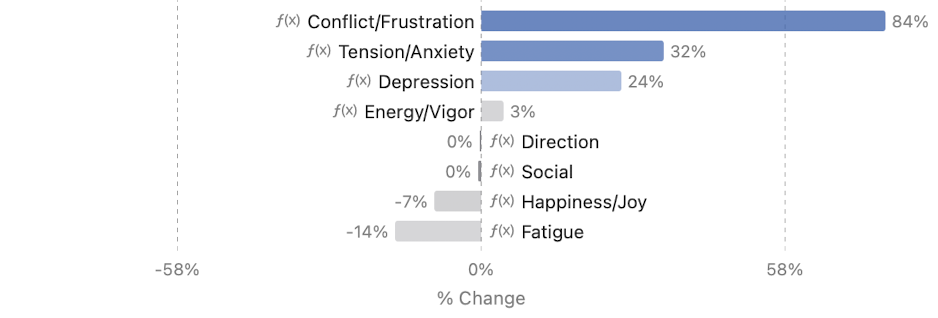
<p><img src="/assets/images/posts/meditation-mood-impact.png" alt="Mood impact of meditation" /></p>

<p>I found meditating more:</p>

<ul>
  <li>Increased my levels of frustration, anxiety and depression.</li>
  <li>Had no impact on my level of vigor, how social I felt, or how directed I felt during the day.</li>
  <li>Lowered my levels of happiness and fatigue, but this difference was not statistically significant.</li>
</ul>

<p>These were somewhat surprising results. There is a plethora of research out there which points to the mental benefits of meditation, such as <a href="https://jamanetwork.com/journals/jamainternalmedicine/fullarticle/1809754">Meditation Programs for Psychological Stress and Well-being</a>, a review paper which summarized 47 research studies and found mindfulness meditation decreased depression and anxiety.</p>

<h3 id="sleep-and-recovery">Sleep and Recovery</h3>

<p>I tracked my sleep and recovery with an <a href="https://ouraring.com/">Oura</a> ring and <a href="https://www.whoop.com/">Whoop</a> wrist band.</p>

<h4 id="oura-ring">Oura Ring</h4>

<p><img src="/assets/images/posts/meditation-oura-results.png" alt="Oura ring sleep results" /></p>

<p><img src="/assets/images/posts/meditation-oura-stats.png" alt="Oura ring sleep stats" /></p>

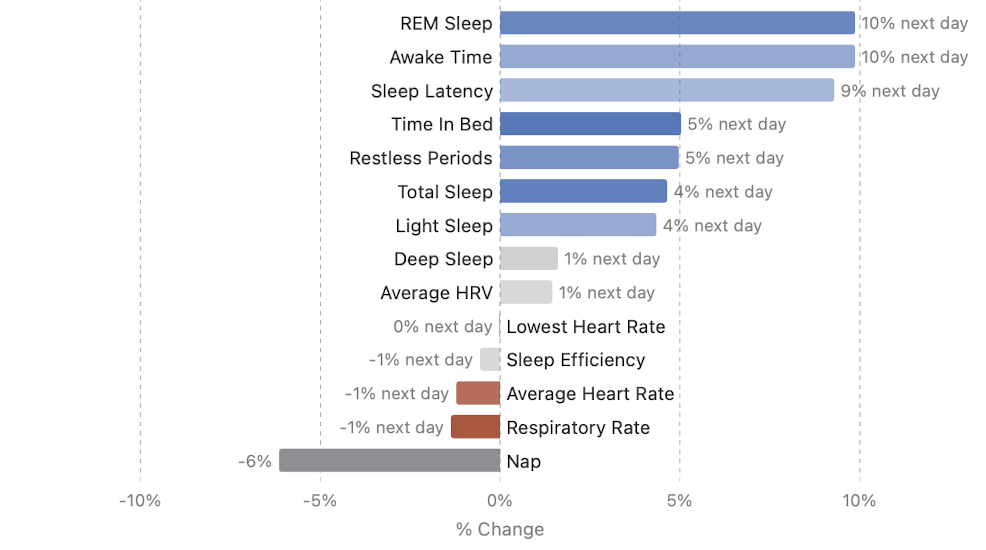
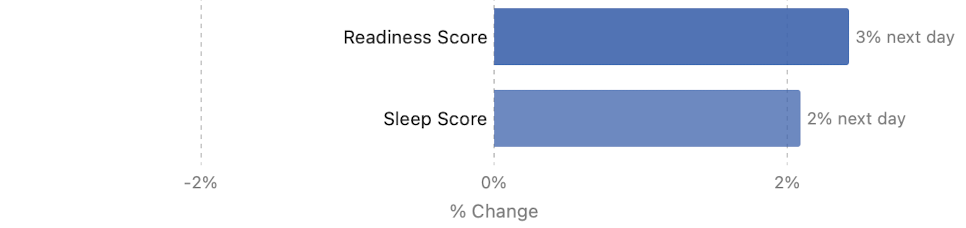
<p>I found that meditating more increased my readiness score the next day, increased my sleep score and sleep duration, and significantly increased my REM sleep the night after meditating. There was also a very small, but significant decrease in average heart rate and respiratory rate the night after meditating more.</p>

<h4 id="whoop">Whoop</h4>

<p><img src="/assets/images/posts/meditation-whoop-results.png" alt="Whoop recovery results" /></p>

<p><img src="/assets/images/posts/meditation-whoop-stats.png" alt="Whoop recovery stats" /></p>

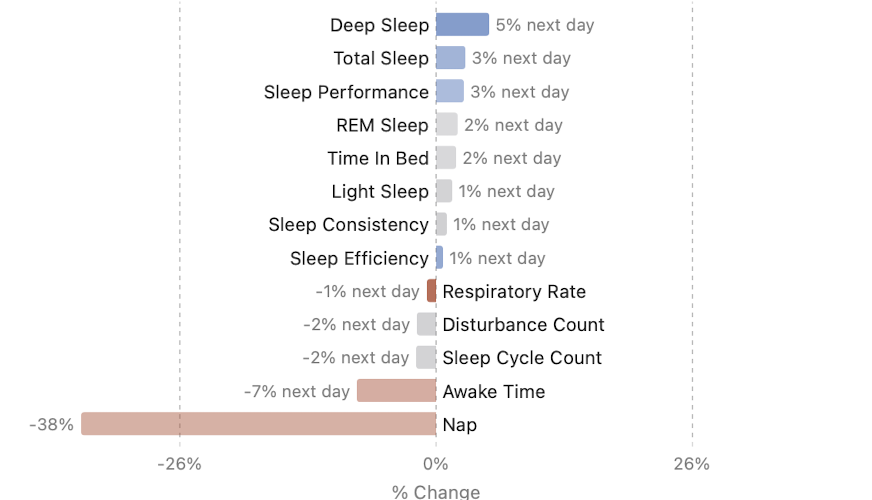
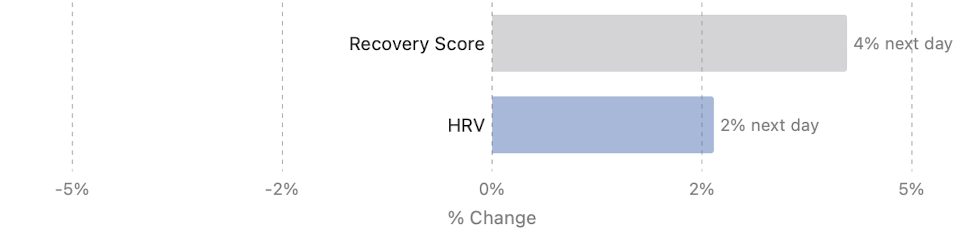
<p>I found that meditating more increased my recovery score the next day by 4% (though not statistically significant), increased my sleep performance, sleep duration, HRV and significantly increased my deep sleep the night after meditating. I napped less on days when I meditated more. There was also a very small, but significant decrease in respiratory rate the night after meditating more, and I spent less time awake during the night.</p>

<p>While both wearables showed improvements in sleep, the two wearables didn’t quite agree on the magnitude of changes for different sleep stages. Oura showed more of a REM sleep increase than deep sleep, and I trust the Whoop data on naps more as Oura sometimes doesn’t pick up when I take a nap, and it’s impossible to manually add sleep sessions that weren’t automatically detected with Oura.</p>

<h2 id="discussion">Discussion</h2>

<p>This wasn’t the first experiment on meditation I have performed with Reflect. I ran two shorter experiments in 2024:</p>

<ol>
  <li>A 90 day random experiment comparing no meditation to 30 minutes of meditation per day (split across two sessions)</li>
  <li>A 31 day experiment comparing 15 minutes to 30 minutes</li>
</ol>

<p>I trust the results of these experiments less, as they were both shorter, and the 90 day one had only 87% compliance as opposed to the &gt;99% compliance in the remaining two.</p>

<p><img src="/assets/images/posts/meditation-mood-0v30.png" alt="Mood impact with 0 min vs 30 min meditation (90 day experiment)" />
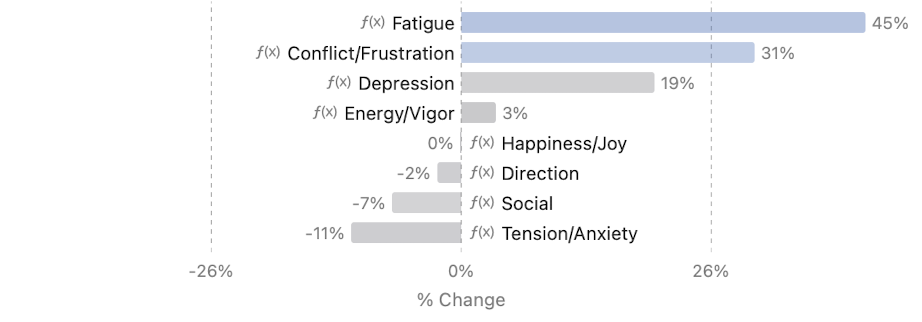
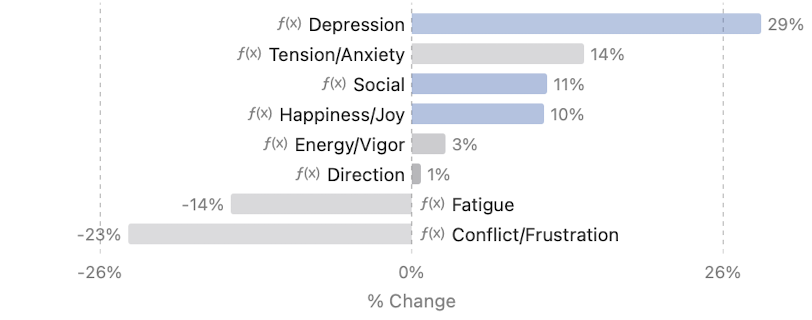
<em>Mood impact with 0 min vs 30 min meditation (90 day experiment)</em></p>

<p>The results disagreed for many of the measured mood areas, but an increase in depression was the most consistent finding across all three.</p>

<p><img src="/assets/images/posts/meditation-mood-15v30.png" alt="Mood impact with 15 min vs 30 min meditation (31 day experiment)" />
<em>Mood impact with 15 min vs 30 min meditation (31 day experiment)</em></p>

<p>The previous two experiments showed similar directional findings with the wearable data from Oura and Whoop on sleep and recovery:</p>

<ul>
  <li>They all found increases in sleep score and readiness/recovery score</li>
  <li>Total sleep and sleep stages increased in all experiments, <em>except</em> for deep sleep decreasing in the shortest experiment</li>
  <li>HRV was consistently higher</li>
</ul>

<h2 id="next-steps">Next Steps</h2>

<p>I’m not sure how to interpret the increases in certain negative emotions, as they seem to conflict with published research on the topic. I have heard from other meditators that they have observed similar increases in negative emotion, and interpreted it as being more in tune with their emotional responses instead of bottling them up.</p>

<p>My baseline levels of negative emotion are pretty low, so a small increase in negative emotion doesn’t represent a large difference. I’m interested in continuing to tinker with this with further experiments, and I suspect some of the effects of meditation are likely cumulative, so even doing an experiment with a random daily schedule of meditating vs not is unlikely to show the full picture. Something like alternating phases of weeks or months might be more informative.</p>

<p>I also have several years of combined data on meditation, mood, and Oura data going back to 2018. I am currently in the process of identifying and retroactively analyzing periods of time when I alternated between meditation and no meditation, and will write about my findings here.</p>]]></content><author><name></name></author><summary type="html"><![CDATA[I recently ran a 204 day long experiment on meditation with Reflect. Each day, I was randomly assigned to meditate either once or twice per day. I usually meditate for 15 minutes per session, so this came out to 15 min vs 30 min of meditation per day. I found it improved my sleep, and impacted my mood in ways I didn’t anticipate.]]></summary></entry></feed>